
Ophthalmology medical billing starts with the reason for the visit: a complaint or disease goes to the medical plan, and a glasses check goes to the vision plan or patient. After that, accurate eye or E/M codes, documented testing, global-period modifiers and correct drug lines prevent most denials.
Eye practices bill routine vision care, medical eye care, surgery packages, testing and injected drugs, and a single visit can involve several of them. This guide shows how the claim is built for each and where it fails. For the company-choice angle, see our guide to choosing a medical billing company.
Key takeaways
- The reason for the visit, shown in the chief complaint and primary diagnosis, decides medical or vision billing.
- Original Medicare does not cover routine eye exams or refractions, so the patient pays for a glasses exam.
- Use one code family per visit, eye exam codes or E/M, and let the note support the level.
- Cataract surgery sits in a 90-day global package, so modifiers 24, 25, 57, 58, 78, 79, 54 and 55 decide later visits.
- Most denials start upstream: wrong plan, mismatched diagnosis, global conflict or a drug line out of step with the dose.
Why is ophthalmology billing different from other specialties?
An eye practice bills routine vision care, which many plans treat as a separate benefit, and medical eye care for disease, which goes to health insurance. It also bills surgery packages, in-office testing and injected drugs. One visit can touch several of these streams, and each has its own rules.
This post explains how the claim is built for each stream and where it breaks. It is about billing mechanics, not vendor choice; for that, read our guide to choosing a medical billing company. For the cataract code choice itself, see the cataract surgery CPT codes guide. Several practical articles we cite are older, so check current code sets and payer policy before changing a workflow.
Do you bill the medical plan or the vision plan?
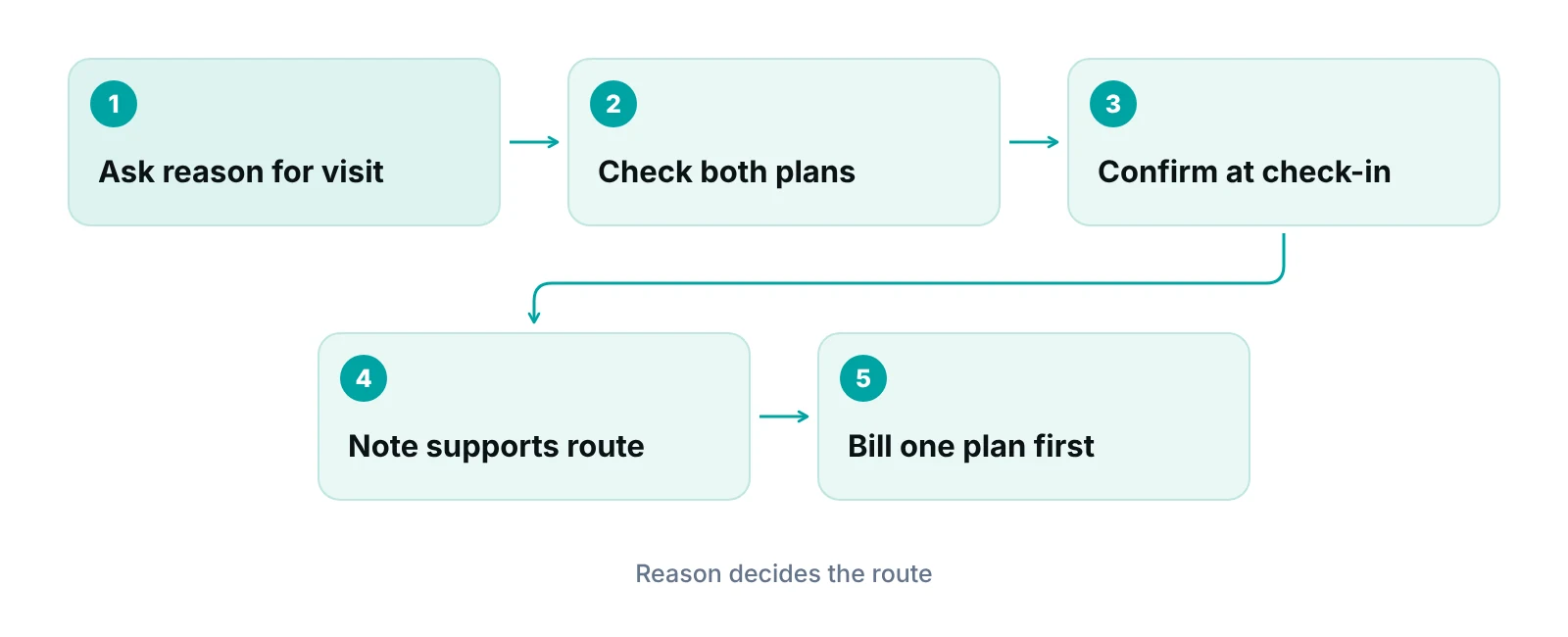
The reason for the visit decides. Three trade sources agree: a visit for a complaint, a disease or follow-up of a condition goes to the medical plan, and a check of vision or a glasses update goes to the vision benefit or the patient (Ophthalmology Management, 2005; AAPC; a practice-billing article).
The chief complaint and history carry the weight. One article says a medical claim needs a medical chief complaint and a documented medical diagnosis, such as diabetes, cataract, macular degeneration or dry eye, and that an exam centered on refractive status and prescriptions is not medical even when the patient has a medical condition. Ophthalmology Management adds that the chief complaint should match the primary diagnosis.
| Situation | Where it usually goes | Common mistake |
|---|---|---|
| Blurred vision, known cataract | Medical plan | Billed to the vision plan because it was booked as an annual exam |
| Healthy patient wants new glasses | Vision plan or patient | Adding a medical diagnosis the exam did not address |
| Routine visit, new finding appears | Routine visit stays routine; return visit is medical | Converting the whole visit to medical after the fact |
| Urgent or emergent eye problem | Medical plan is primary | Sending it to a vision plan |
| Glasses needed after a medical exam | Exam to medical; hardware to vision plan | One claim for exam and hardware |
Source: Ophthalmology Management (2005); AAPC alert (undated); practice-billing article on coordinating plans (undated). Older articles; confirm with each plan.
Incidental pathology found during a routine visit generally does not change coverage for that visit, per the 2005 article; address it at a return visit. Plans also differ on form. Many vision plans ask for HCPCS S-codes for a routine exam, and Medicare does not accept them, per AAPC. Some plans prefer the 92002 to 92014 eye exam codes. Keep a payer note for each plan, not one house rule.
How do refraction, glasses and Medicare fit in?
Refraction is the routine element of a visit that medical carriers usually will not pay, and Original Medicare does not cover it for glasses at all. Medicare.gov says Medicare does not cover routine eye exams, sometimes called eye refractions, and the patient pays all costs under Original Medicare. Some Medicare Advantage plans add vision benefits, so check the plan.
Glasses follow the same rule with one exception. Medicare.gov says Part B covers one pair of standard-frame glasses or one set of contact lenses after cataract surgery that implants an intraocular lens. The patient pays 20 percent after the Part B deductible, pays for upgraded frames, and must use a Medicare-participating supplier. The cataract surgery page adds that Part B may cover surgery with a conventional lens.
Refraction has its own code, 92015, in the sources we read. An older Review of Optometry article says it should be coded separately from the eye exam code, and warns against folding it into the exam code or pairing an exam code with a refractive diagnosis. It is from 2006 and uses ICD-9, so treat it as logic, not current policy.
Read the vision contract before coordinating benefits. One practice-billing article describes billing medical first and then sending the vision plan the primary explanation of payment. It warns that coordination uses up the patient’s vision benefit and can raise out-of-pocket cost on high-deductible plans with HSAs or FSAs, and it advises against a blanket policy. AAPC says to send an E/M or eye code to both plans only when both carriers say so in writing; otherwise it may look like double billing.
Should you report E/M codes or eye exam codes?
Either family can describe a visit, but use one per visit and follow what each payer accepts. The eye exam codes are 92002 and 92004 for new patients and 92012 and 92014 for established patients, per the Review of Optometry and AAPC articles. Office evaluation and management (E/M) codes are the general alternative. The sources we read do not say which is better; your documentation, coder and payer decide.
A level is earned by the note. On a procedure day, the E/M must be separately identifiable: the CMS global surgery booklet defines modifier 25 as a significant, separately identifiable E/M service beyond the usual pre- and post-operative care. See our guide to modifiers 25 and 59 for the general logic.
Medicare correct coding applies too. CMS updates its procedure-to-procedure edits quarterly, per the NCCI page. The 2026 NCCI Policy Manual took effect January 1, 2026, and its Chapter 8 covers CPT 60000 to 69999, which includes the eye, per the CMS manual page.
What does diagnostic testing need to show for medical necessity?
Testing is paid when the chart shows why it was needed, what was found and what was done with the result. A test with no complaint, no diagnosis and no plan looks like a routine screen, and it meets the same wall as a routine exam.
Medicare separates screening from disease care. It covers glaucoma screening for people at high risk, once every 12 months, when done or supervised by an eye doctor legally allowed to do it in the state, per Medicare.gov. High risk means diabetes, a family history of glaucoma, African American and 50 or older, or Hispanic and 65 or older. It is a defined benefit, not cover for any imaging a doctor orders.
Ophthalmic imaging and field testing follow local coverage determinations written by each Medicare contractor, which set supporting diagnoses and repeat limits. We did not retrieve a current policy for this post, so we quote no frequency limits. Find your contractor in the Medicare Coverage Database and keep a one-page extract for techs and coders. A simple standard:
- Order and reason: why this test, for this patient and eye.
- Result and plan: the finding, and what it changed.
- Diagnosis and frequency: the supporting diagnosis is on the claim, and the last test date is visible when the next is booked.
How do cataract surgery and global periods affect billing?
Surgery is paid as a package, and the package decides which later visits can be billed. Per the CMS global surgery booklet (December 2025), a 90-day global period for a major procedure covers one pre-operative day, the surgery day and 90 days after, 92 days in all. It includes intra-operative services, post-operative recovery visits and pain management, and care for complications that do not need a return to the operating room. Cataract surgery is generally handled as a 90-day procedure, so a routine check on day 30 falls inside the package.
The code choice is in our cataract guide, so we do not repeat it. Table 2 shows the modifiers that most often decide whether a claim inside the package is paid.
| Modifier | Meaning in the CMS booklet | Eye-practice example |
|---|---|---|
| 57 | The E/M visit that leads to the first decision for major surgery, day before or day of | The exam where cataract surgery is decided |
| 24 | An unrelated E/M by the same provider in the post-operative period | A visit for an unrelated problem a month later |
| 25 | A significant, separately identifiable E/M on the procedure day | A new problem evaluated on a minor procedure day |
| 78 | An unplanned return to the operating or procedure room for a related procedure | Return to surgery for a complication |
| 79 | An unrelated procedure by the same provider in the period; a new period starts | Surgery on an unrelated condition |
| 54 and 55 | 54: surgeon provides only part of the package. 55: another provider provides post-operative care only, with a written transfer in the record | Co-management with an optometrist |
Source: CMS, Global Surgery Booklet MLN907166 (December 2025). Examples are illustrations, not CMS text. Modifier 58 (staged or planned procedures) also applies.
On co-management, the booklet says modifier 54 applies whenever the surgeon plans to provide only part of a package, even with an informal transfer. CMS’s CY 2026 fee schedule final rule (October 31, 2025) made no global surgery payment change but asked for comment on how shares are set when transfer-of-care modifiers apply to 90-day packages, per its fact sheet.
“Most global-period denials are scheduling and charting problems that surface late in billing. Fix them where the visit is booked and written.”
— Awais Afzal, Healthcare Operations & Data Analyst
How are injections and drugs billed?
A drug given in the office is billed as its own line, separate from the service of giving it. The drug is reported with a HCPCS Level II code, the J-code family for many injectables, and the units must reflect the dose. Level II codes run from A0000 to V9999, which Chapter 12 of the NCCI Policy Manual covers.
We did not retrieve a current contractor billing article for any eye drug, so we list no specific codes, modifiers or unit conversions. Those change by quarter and differ by contractor. What holds in general:
- The drug line and the administration line are separate; a denial on one does not fix the other.
- Units must match the dose and the code’s unit definition, or the claim underpays or denies.
- Discard is a known issue. CMS’s CY 2026 final rule fact sheet notes manufacturers must refund Medicare for specified discarded amounts of certain single-dose drugs, so expect contractor rules on reporting it.
- Record the last drug and date per eye, because plan authorization and step therapy rules turn on it.
Where do ophthalmology denials come from?
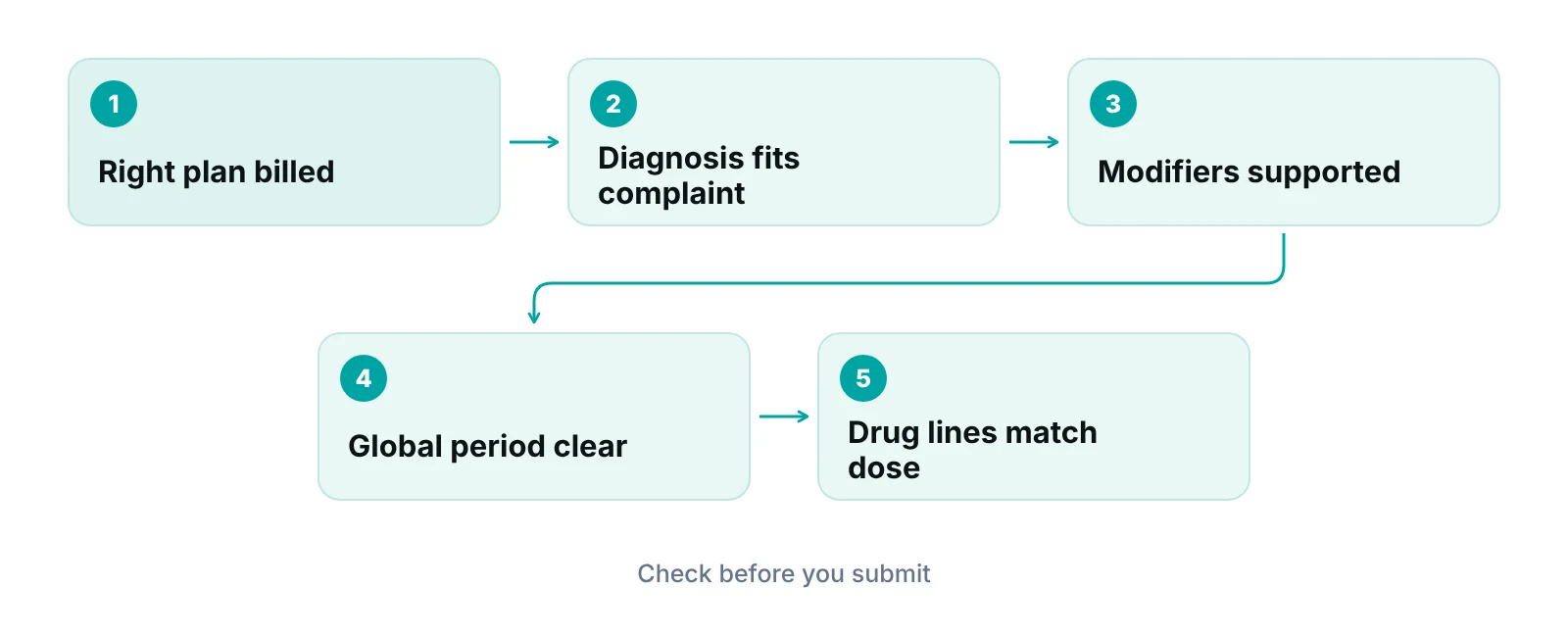
Most eye-care denials trace to a few upstream mistakes: the wrong plan, a diagnosis that does not match the complaint, a missing modifier, a global-period conflict, a drug line out of step with the dose, and thin documentation. Our denial management guide covers working denied claims, and the guide to billing denials explains the general categories. Table 3 maps them to eye care.
| Denial trigger | Why it happens | Upstream fix |
|---|---|---|
| Wrong plan billed | Booked as annual exam, but the complaint is medical, or the reverse | Ask the reason at booking; confirm at check-in |
| Diagnosis does not support the service | Exam code with a refractive diagnosis, or complaint differs from primary diagnosis | Template ties complaint to first diagnosis |
| Refraction in the exam code | Routine element reported as medical | Report refraction separately, to the right payer |
| Global-period conflict | Visit or procedure in the package without the right modifier | Show the package end date by eye |
| Bundling edit | Two codes that Medicare edits treat as a pair | Scrub against current NCCI edits; modifier only when supported |
| Vision benefit used up | Coordination exhausted the allowance | Check the benefit first; tell the patient |
Source: Review of Optometry (2006); AAPC; Ophthalmology Management (2005); CMS NCCI and global surgery documents. Synthesis by RCM Finder.
How do you build this into daily operations?
Put the sorting at the front desk and the checks before submission. Our ophthalmology practice management guide covers wider operations, and our ophthalmology website design post shows how a booking form can ask whether the visit is for a problem or for glasses. Marketing sets expectations too: see ophthalmology marketing and ophthalmology SEO, and keep what the website promises in line with what billing can deliver.
Our revenue cycle management service works inside your existing EHR, for example PrognoCIS, eClinicalWorks or athenahealth. Our virtual medical assistants can handle coverage checks in your practice’s time zone, and our practice management system tracks claims by stage, checks data completeness before submission and flags payments below the expected amount.
Any outside billing vendor handling patient data is a business associate. HHS lists billing and claims processing among those functions, and a Business Associate Agreement is generally required, per HHS; the minimum necessary standard limits access by role. We put a Business Associate Agreement in place before accessing patient data, and use role-based access, audit logging and encrypted (HTTPS) connections.
Want to see where your eye claims leak?
A free practice audit reviews recent visit, surgery and injection claims and the denials behind them. Pricing is quoted after the audit.
Our recommendations
- Ask the reason for the visit at booking. Glasses checks and problem visits take different routes. Record the reason before arrival and confirm it at check-in.
- Make the note carry the route. Tie the chief complaint to the first diagnosis. If the note reads as a refractive exam, bill it as one.
- Keep one payer sheet per vision plan. Record the codes it wants and whether it accepts coordination. Do not run one house rule.
- Show the global period by eye. Show the package end date for each surgical eye to schedulers and coders, and check modifiers on any visit inside it.
- Standardize the testing order. Order, finding and plan in one template. Keep the last test date per eye visible when booking the next one.
- Log each injection against the claim. Match the drug line to the injection log for dose, units, discard and eye, then compare payment to expected.
Bottom line
Ophthalmology medical billing works when the visit is sorted at booking, the note supports the route, and the claim is checked for plan, diagnosis, modifiers, global period and drug lines before it leaves. If you want a second review of how your eye claims are built, our revenue cycle management service starts with a free practice audit.
Frequently asked questions
Do you bill medical insurance or the vision plan for an eye exam?
It depends on the reason for the visit. A visit for a complaint, a disease or follow-up of a condition goes to the medical plan, and a check of vision or a glasses update goes to the vision plan or the patient. The chief complaint and the primary diagnosis in the note should match the route you chose.
Does Medicare pay for a routine eye exam or refraction?
No. Medicare.gov says Original Medicare does not cover routine eye exams, sometimes called eye refractions, and the patient pays all costs. Some Medicare Advantage plans include vision benefits, so check the plan. Medicare can pay for covered medical eye care, such as eye disease evaluation.
Can you bill both the medical plan and the vision plan for one visit?
Sometimes, but only with care. Some practices bill the exam to medical and the refraction to the vision plan. AAPC advises sending an E/M or eye code to both plans only when both carriers tell you to in writing, and coordination can use up the patient’s vision benefit. Read the contract first.
What are the eye exam codes, and how do they differ from E/M?
The ophthalmology exam codes are 92002 and 92004 for new patients and 92012 and 92014 for established patients. Office E/M codes are the general alternative. Use one family per visit, match the level to the note, and follow what each payer accepts.
How long is the global period for cataract surgery?
Cataract surgery is a major procedure, and the CMS global surgery booklet says major procedures have a 90-day global period, covering one day before, the surgery day and 90 days after. Confirm the indicator for each code on the current Medicare fee schedule file.
Why are eye injection claims denied?
Common causes are units that do not match the dose, discard reported the wrong way, the wrong eye or modifier, and missing authorization or step therapy history. The specifics are set by each payer and Medicare contractor, so check your contractor’s current billing article for the drug.
Get your free practice audit
Tell us about your practice. We will contact you using the details you give.
- A review of your recent claims, denials and A/R aging
- Where your front desk and prior authorizations slow payment
- A prioritized fix list you keep, whether or not you hire us
Pricing is quoted after the audit, based on your volume and the services you choose. Prefer to talk? Call +1 (302) 556-2288.
Sources
- How to coordinate medical and vision plan billing — Review of Ophthalmology (reviewob.com) (undated)
- Bill your patients' medical insurance the right way — Review of Optometry (2006)
- Eye exams (routine) — Medicare.gov (2026)
- Eyeglasses and contact lenses — Medicare.gov (2026)
- Cataract surgery — Medicare.gov (2026)
- Glaucoma screenings — Medicare.gov (2026)
- Resolve medical vs vision insurance coding mixups — AAPC (undated)
- Coding and reimbursement: medical exam or vision exam — Ophthalmology Management (2005)
- Global Surgery Booklet (MLN907166) — CMS (2025)
- Calendar Year 2026 Medicare Physician Fee Schedule Final Rule (CMS-1832-F) fact sheet — CMS (2025)
- National Correct Coding Initiative edits — CMS (2026)
- Medicare NCCI Policy Manual — CMS (2026)
- Business Associates — HHS (2026)
- Minimum Necessary Requirement — HHS (2026)
Disclaimer: This article is educational and is not legal, coding, clinical or compliance advice. CPT is a registered trademark of the American Medical Association, and its official descriptors are not reproduced here. Payer rules and Medicare contractor policies differ and change often, and several sources cited here are older, so confirm current requirements with your payers, your Medicare contractor and a qualified coder before acting.