
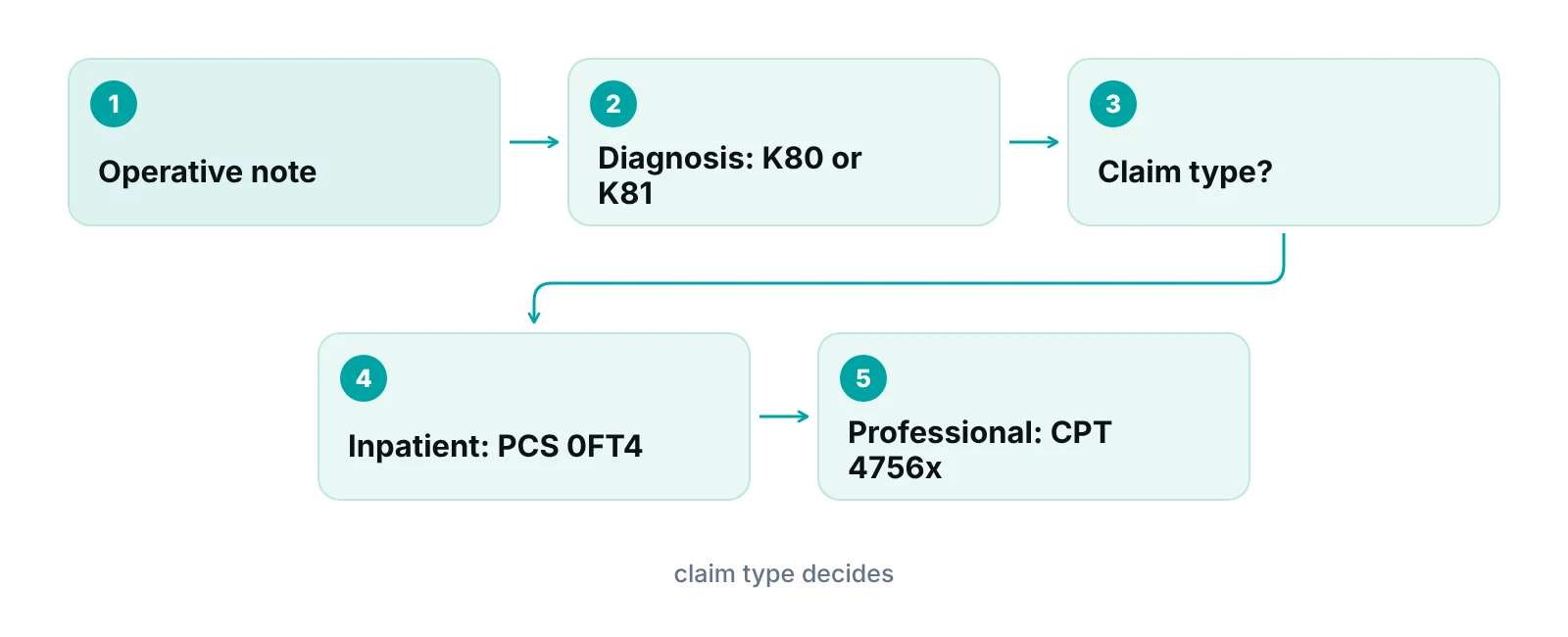
There is no single cholecystectomy ICD-10 code. The reason for surgery is an ICD-10-CM diagnosis, usually K80 for gallstones or K81 for cholecystitis without stones. The procedure itself is ICD-10-PCS (0FT4 series) on inpatient facility claims and CPT (47562 to 47610) on professional and outpatient claims.
Searches for “cholecystectomy icd 10” mix up three different code sets. Coders need the diagnosis code that explains why the gallbladder came out, and then the procedure code that fits the claim they are building. This guide separates the two sides, shows how to choose within K80 and K81, and lists the edits that cause returned claims. Every code below was checked against the sources listed at the end of the post.
Key takeaways
- Diagnosis (ICD-10-CM) and procedure (ICD-10-PCS or CPT) are separate lookups; the claim type decides the procedure code set.
- Gallstones with cholecystitis go to K80; cholecystitis without stones goes to K81, and K81 carries an Excludes1 note for K80.
- Inpatient facility claims use ICD-10-PCS 0FT4 codes for removal of the whole gallbladder; professional claims use CPT 47562 to 47610.
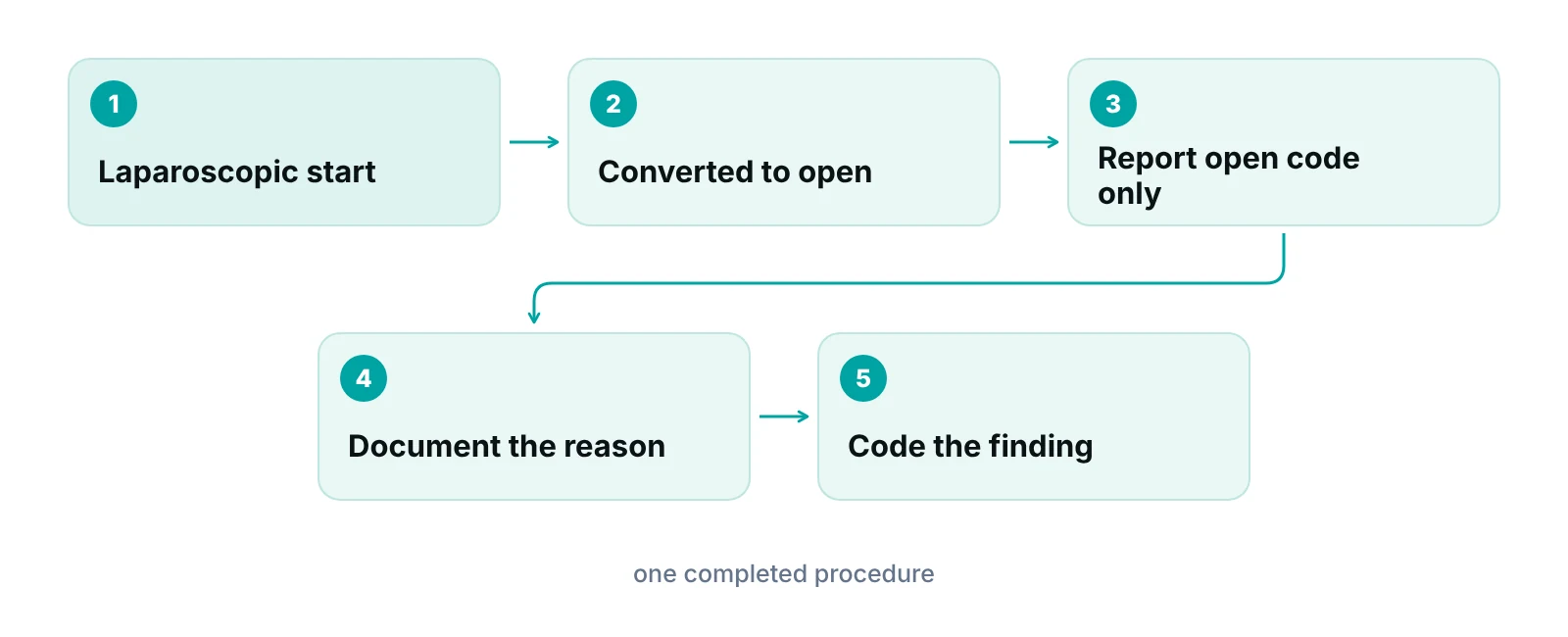
- A converted laparoscopic case is reported as the open procedure; CMS NCCI says the failed laparoscopic code is not separately reportable.
- Do not use a “gallbladder absent” status code on the claim for the surgery itself.
Why does a cholecystectomy need more than one code?
A gallbladder removal produces a diagnosis, a procedure and, on some claims, a status or aftercare code. Each lives in a different code set, and the claim type decides which procedure code set applies. Mixing them is the most common source of confusion for this search term.
The diagnosis side is ICD-10-CM. CMS and CDC publish new files every year, and the FY 2027 files cover discharges and encounters from October 1, 2026 through September 30, 2027 (CMS ICD-10 page). The inpatient procedure side is ICD-10-PCS, whose official guidelines state that the system classifies procedures in hospital inpatient settings (ICD-10-PCS Official Guidelines). For claims that are not inpatient, Medicare NCD 100.13 tells billers to report the CPT code for surgical laparoscopic cholecystectomy and the CPT code for laparoscopic cholecystectomy with cholangiography.
| Question | Code set | Where it is reported | Example |
|---|---|---|---|
| Why was the gallbladder removed? | ICD-10-CM diagnosis | Every claim type | K80.00, K81.1 |
| What was done, on an inpatient facility stay? | ICD-10-PCS procedure | Hospital inpatient claim | 0FT44ZZ |
| What was done, on a professional claim? | CPT procedure | Surgeon and assistant claim | 47562, 47563 |
| What was done, on a non-inpatient claim? | CPT procedure | Outpatient claim (Medicare NCD 100.13 points to CPT) | 47562 |
| What is the patient status afterward? | ICD-10-CM status or aftercare | Later encounters, not the surgery claim | Z90.49, Z48.815 |
Source: CMS, ICD-10 codes page (accessed Nov 2026); CMS, ICD-10-PCS Official Guidelines (2025); CMS, NCD 100.13 Laparoscopic Cholecystectomy.
For the claim-form side of this split, see our guides to institutional versus professional claims, the UB-04 claim form and the CMS-1500 claim form.
What are the ICD-10-CM diagnosis codes for gallbladder removal?
The diagnosis code names the condition that justified the surgery. Most gallbladder removals land in K80 (cholelithiasis), K81 (cholecystitis) or K82 (other gallbladder disease). Table 2 lists the codes coders reach for first. These codes were read from the Tabular text and cross-checked with code-list pages; FY 2027 changes to chapter 11 were reviewed through a change log, which lists no change to K80, K81 or K82.
| Code | What it describes | Use it when |
|---|---|---|
| K80.00 | Gallbladder stone with acute cholecystitis, no obstruction | The provider documents stones and acute inflammation, and no obstruction |
| K80.01 | Same, with obstruction | The same picture, and the provider documents obstruction |
| K80.10 | Gallbladder stone with chronic cholecystitis, no obstruction | Stones with chronic inflammation; the Tabular also lists cholelithiasis with cholecystitis NOS here |
| K80.12 | Gallbladder stone with acute and chronic cholecystitis, no obstruction | Both acute and chronic inflammation are documented with stones |
| K80.20 | Gallbladder stone without cholecystitis, no obstruction | Symptomatic stones (for example colic) with no cholecystitis documented |
| K81.0 / K81.1 / K81.9 | Cholecystitis without stones: acute, chronic, unspecified | Inflammation is documented and stones are not; K81 has an Excludes1 note for K80 |
| K80.50 | Bile duct stone without cholangitis or cholecystitis | Choledocholithiasis only; stones in both gallbladder and duct go to K80.6- (with cholecystitis) or K80.7- (without) |
| K82.8 | Other specified gallbladder disease | The provider documents a specified condition such as dyskinesia |
Source: ICD-10-CM Tabular List text (FY 2025 edition, via a third-party reference); AAPC and FindACode code lists (accessed Nov 2026). Re-check against the FY 2027 Tabular List.
Not billable at the 3-character level
K80 and K81 are category headers. K80 needs the 4th and 5th characters (for example K80.00), while K81 needs a 4th character (K81.0, K81.1, K81.2 or K81.9). A claim with a bare category is rejected as an invalid code.
How do you choose between K80, K81 and K82?
Choose by what the provider documents about stones, inflammation and obstruction, in that order. The Tabular List supplies the guardrails, and the FY 2027 ICD-10-CM Official Guidelines explain how Excludes1 notes behave.
- Stones with inflammation. If the record documents a gallbladder stone and cholecystitis, use the K80.0 to K80.1 combination codes. K81 carries an Excludes1 note for cholecystitis with cholelithiasis (K80.-), and the guidelines treat an Excludes1 note as “NOT CODED HERE” except where the two conditions are unrelated.
- Acute, chronic or both. The 4th character separates acute (K80.0), chronic or other (K80.1) and stones without cholecystitis (K80.2). Inside K80.1, the 5th character separates chronic, acute and chronic, and other cholecystitis, and the final character reports obstruction.
- Obstruction. For gallbladder stones the last character is “without obstruction” or “with obstruction.” Do not default to “without” when the note is silent; query the surgeon.
- Gangrene or perforation. Under K80.0, K80.1 and K81, the Tabular carries a “use additional code” note for gangrene (K82.A1) or perforation (K82.A2) of the gallbladder in cholecystitis. Add it only when the provider documents the finding.
- Bile duct stones. Choledocholithiasis is K80.5-, and stones in both gallbladder and duct with cholecystitis are K80.6-. A bile duct stone also changes the procedure code, because common duct exploration has its own CPT codes.
- Symptoms before a diagnosis. The FY 2027 guidelines allow sign and symptom codes when the provider has not confirmed a related diagnosis, and when no definitive diagnosis is established by the end of the encounter. Do not assign a gallstone code from an imaging impression the surgeon has not adopted.
Related reading: our guides to abdominal surgery ICD-10 codes and pre-operative ICD-10 codes cover how surgical and pre-operative diagnoses are sequenced, so this section stays on gallbladder-specific choices.
What are the cholecystectomy procedure codes (ICD-10-PCS and CPT)?
On an inpatient facility claim the procedure is an ICD-10-PCS code in the 0FT4 series. On a professional claim it is a CPT code in the 47562 to 47610 range. The two are not interchangeable, so confirm the code set before a code reaches the claim.
In ICD-10-PCS, the root operation depends on how much of the organ comes out. The official guidelines say that resection of a body part is coded when all of the body part is cut out or off, and partial removal is coded as excision (guideline B3.8). A whole-gallbladder removal is therefore a resection (0FT4), and a partial removal is an excision (0FB4). The approach character separates open (0) from percutaneous endoscopic (4), the usual laparoscopic approach.
| Claim type | Code | Plain-language meaning |
|---|---|---|
| Inpatient facility (ICD-10-PCS) | 0FT40ZZ | Resection of gallbladder, open approach |
| Inpatient facility (ICD-10-PCS) | 0FT44ZZ | Resection of gallbladder, percutaneous endoscopic approach |
| Inpatient facility (ICD-10-PCS) | 0FT44ZG | Same, hand-assisted qualifier |
| Inpatient facility (ICD-10-PCS) | 0FB4 series | Excision (partial removal) of gallbladder; only when the note supports partial removal |
| Professional or outpatient (CPT) | 47562 / 47563 / 47564 | Laparoscopic removal; with cholangiography; with common bile duct exploration |
| Professional or outpatient (CPT) | 47600 / 47605 / 47610 | Open removal; with cholangiography; with common bile duct exploration |
Source: FindACode ICD-10-PCS 0FT group; AAPC code page for 0FT44ZZ; CMS MS-DRG v44.0 Definitions Manual (FY 2027); AAPC General Surgery Coding Alert (2007); Coding Ahead CPT list. CPT descriptions are paraphrased; CPT is owned by the AMA.
For hospital grouping, the CMS MS-DRG v44.0 manual for FY 2027 places the 0FB4 gallbladder excision codes in the cholecystectomy groupings: open and other non-laparoscopic procedures in the 411-416 range and laparoscopic ones in 417-419. DRG assignment also depends on secondary diagnoses and complications, so a grouper should confirm the final result.
Which CMS rules affect the professional cholecystectomy claim?
CMS NCCI policy removes several add-on claims from a cholecystectomy. The NCCI Policy Manual for Medicare Services (2025) say that when a laparoscopic cholecystectomy is converted to an open cholecystectomy, the failed laparoscopic cholecystectomy and a diagnostic laparoscopy are not reported, and that a diagnostic laparoscopy is never separately reportable with a surgical laparoscopy of the same body cavity at the same encounter.
- Cholangiography. The CPT set has separate codes for removal with cholangiography (47563, 47605). Pick the code that matches what the operative note describes rather than adding imaging on top of a base code.
- Duct exploration. 47564 and 47610 describe removal with common bile duct exploration. A dated 2007 AAPC article reports that the NCCI edits bundled 47563 into 47564 and 47605 into 47610. Check the current NCCI procedure-to-procedure edit tables before relying on that point.
- Unusual work. The same AAPC article says modifier 22 should be used sparingly and only when the note clearly shows work beyond the described code. Payers differ, so review each payer policy.
- Diagnosis linking. Link the primary line to the K80 or K81 code the surgeon documented. Add findings that drove a conversion as additional diagnoses, with support in the note.
Global-period and modifier questions follow general surgery rules. Our guides to modifier 79 and modifiers 25 and 59 cover those without repeating them here.
What must the surgeon document for these codes to hold?
Each code above rests on a statement in the operative report or the history and physical. If the record is silent, the coder defaults to a less specific code, and the claim may pay less or fail an edit.
- The indication in words the code set recognizes: stones, acute or chronic cholecystitis, obstruction, gangrene or perforation.
- The approach: laparoscopic, open, hand-assisted, or converted, with the reason for conversion.
- Whether the whole gallbladder or only part was removed. This decides resection versus excision on inpatient claims.
- Whether cholangiography or common bile duct exploration was performed, and what was done to the duct.
- The final diagnosis once pathology or intraoperative findings are known, so the coder is not forced to code from the pre-operative impression.
A query that saves a claim
If the note says “cholecystitis” and imaging says “stones,” ask the surgeon one question: were stones present and are they part of the diagnosis? The answer decides between K81 and K80.
What causes cholecystectomy claims to be returned or denied?
Most returns trace to a code-set mismatch, an Excludes1 conflict, or a bundled add-on. The list below uses payer-neutral wording; exact edit names vary by payer and clearinghouse.
- Invalid or truncated diagnosis. A 3-character category such as K80 or K81 submitted as if complete.
- Excludes1 conflict. K81.- reported together with a K80.- code for the same gallbladder.
- Wrong code set. An ICD-10-PCS code on a professional claim, or a CPT code on the inpatient procedure line.
- Bundled diagnostic laparoscopy or failed attempt. A diagnostic laparoscopy, or the abandoned laparoscopic code, reported with the open procedure.
- Approach mismatch. A percutaneous endoscopic PCS code where the note describes an open or converted case.
- Status code on the surgery claim. Z90.49 (acquired absence of other specified parts of the digestive tract) used when the gallbladder is still present at the time of service.
Run these checks before submission. Our guide to claim scrubbing explains how a pre-bill review catches code-pair edits, and denial management covers what to do once a denial arrives. Denial-specific support is available through our denial management services.
Are surgical claims coming back with code-pair edits?
Send a sample of returned surgical claims with the operative notes. A free practice audit can show whether the cause is the diagnosis choice, the procedure code set or a payer edit.
Which codes apply after the gallbladder is removed?
After surgery the patient has a status, aftercare or complication picture, and those codes belong on later encounters. They answer a different question from the surgery claim.
- Z90.49. Acquired absence of other specified parts of digestive tract. The Index entry for gallbladder (acquired) leads here (cross-checked on a code reference site).
- Z48.815. Encounter for surgical aftercare following surgery on the digestive system. The Z48 category has an Excludes1 note for follow-up examination after completed treatment (Z08-Z09).
- K91.5. Postcholecystectomy syndrome. Report it only when the provider diagnoses it; K82 and K83 both carry an Excludes1 note that points to K91.5.
- K91.86. Retained cholelithiasis following cholecystectomy. K80 has an Excludes1 note for this code, so a retained stone is not coded as a new K80 gallstone.
The status and aftercare Z codes were checked on code reference pages. The aftercare guidelines in Section I.C.21 were not readable in the sources fetched for this post, so confirm sequencing rules there.
Worked example: one gallbladder case, two claims
Example only (made up, de-identified)
A surgeon documents acute cholecystitis with a gallbladder stone, no obstruction, no gangrene or perforation. The operation is a laparoscopic cholecystectomy with intraoperative cholangiography, completed laparoscopically.
- Diagnosis. Stone plus acute cholecystitis, no obstruction: K80.00. K81.0 is not added because K81 has an Excludes1 note for K80.
- Professional claim. CPT 47563 (laparoscopic removal with cholangiography), linked to K80.00. No separate diagnostic laparoscopy.
- Inpatient facility claim. K80.00 as the diagnosis and ICD-10-PCS 0FT44ZZ for resection of the whole gallbladder through a percutaneous endoscopic approach, subject to the facility coder’s review of the full record.
- If the case had converted to open. Report the open procedure only (for example 47605 if the cholangiography was done, professional side), document why, and code any finding that drove the conversion.
- At the six-week visit. The status and aftercare codes in the section above apply to that encounter, not the surgery claim.
“Coders do not choose a cholecystectomy code from the word "cholecystectomy." They choose from the claim type and the sentence the surgeon wrote about stones and inflammation.”
— Awais Afzal, Healthcare Operations & Data Analyst
Our recommendations
- Split your cheat sheet by claim type. We keep three lists, not one: diagnosis (ICD-10-CM), inpatient procedure (ICD-10-PCS) and professional or outpatient procedure (CPT). If a coder pulls a code from the wrong list, the claim fails before a payer reads it.
- Add stones, inflammation and obstruction to the surgeon template. Give the operative note three prompts so K80 versus K81 and the obstruction character are never guesses.
- Build an Excludes1 check for K80 and K81. A simple pre-bill rule that flags K81.- with K80.- on the same claim removes a recurring edit.
- Treat conversions as their own workflow. Route converted cases to a coder who confirms the completed approach, the reason for conversion and the findings, using the CMS NCCI rule for failed attempts.
- Re-check codes every October. Each October 1 brings new code files. Re-verify your gallbladder code list against the new Tabular List, and do not rely on last year’s list.
- Ask for a free practice audit. If surgical claims are returning, send a sample. We review where the diagnosis, procedure code set or payer edit breaks, and we quote pricing only after the audit.
Bottom line
A cholecystectomy claim is two lookups: a K80 or K81 diagnosis for the reason, and a procedure code from the code set that fits the claim, ICD-10-PCS 0FT4 for inpatient facility stays and CPT 47562 to 47610 for professional and outpatient claims. Keep status codes off the surgery claim. If surgical claims keep coming back, our medical billing services can review where they fail, and you can ask for a free practice audit.
Frequently asked questions
What is the ICD-10 code for a cholecystectomy?
There is no single code. The reason for surgery is an ICD-10-CM diagnosis such as K80.00 or K81.1. The procedure is an ICD-10-PCS code such as 0FT44ZZ on an inpatient facility claim, or a CPT code such as 47562 on a professional or outpatient claim.
What is the ICD-10-PCS code for a laparoscopic cholecystectomy?
0FT44ZZ describes resection of the gallbladder by a percutaneous endoscopic approach. 0FT40ZZ is the open approach, and 0FT44ZG is the hand-assisted qualifier. Partial removal is an excision (0FB4 series) instead. Facility coders confirm the final code against the operative note, because the approach and the amount of gallbladder removed change the code. Hospital grouping software then assigns the MS-DRG from the full set of codes.
Do I report a diagnostic laparoscopy with a cholecystectomy?
No, under CMS NCCI policy a diagnostic laparoscopy is never separately reportable with a surgical laparoscopy of the same body cavity at the same encounter. That policy comes from the NCCI Policy Manual; other payers may have their own rules, so check the payer policy.
How do I code a laparoscopic cholecystectomy that converts to open?
Report the open procedure that was completed. The NCCI manual says the failed laparoscopic cholecystectomy is not separately reportable. Document the reason for conversion and code the finding behind it as a diagnosis.
Which code shows that the gallbladder has been removed?
Z90.49 (acquired absence of other specified parts of digestive tract) is the status code. Use it on later encounters when the absence matters. It does not belong on the claim for the surgery itself, because the gallbladder was present at that service. For pain or symptoms after removal, the provider must document a diagnosis such as postcholecystectomy syndrome (K91.5) before you report it.
When do I use K81 instead of K80?
Use K81 when cholecystitis is documented without gallbladder stones. When stones are present with cholecystitis, use the K80 combination codes. K81 carries an Excludes1 note for K80, so the two are not reported together for the same gallbladder.
Get your free practice audit
Tell us about your practice. We will contact you using the details you give.
- A review of your recent claims, denials and A/R aging
- Where your front desk and prior authorizations slow payment
- A prioritized fix list you keep, whether or not you hire us
Pricing is quoted after the audit, based on your volume and the services you choose. Prefer to talk? Call +1 (302) 556-2288.
Sources
- ICD-10-CM Official Guidelines for Coding and Reporting, FY 2027 — CDC / NCHS (2026)
- ICD-10-CM FY 2027 file directory — CDC / NCHS (2026)
- ICD-10 codes page — CMS (2026)
- ICD-10-PCS Official Guidelines for Coding and Reporting (2025) — CMS (2025)
- NCD 100.13 Laparoscopic Cholecystectomy — CMS Medicare Coverage Database (1991)
- NCCI Policy Manual for Medicare Services (2025 complete) — CMS (2025)
- ICD-10-CM Tabular List text, K80-K87 (2025 edition) — Skyscape (third-party reference) (2025)
- ICD-10-CM Tabular List text, K90-K95 (2025 edition) — Skyscape (third-party reference) (2025)
- ICD-10-CM Diagnosis Codes in Group K80 — FindACode (2026)
- ICD-10-PCS Procedure Codes in Group 0FT — FindACode (2026)
- Resection of Gallbladder, Percutaneous Endoscopic Approach 0FT44ZZ — AAPC (2026)
- ICD-10-CM/PCS MS-DRG v44.0 Definitions Manual (FY 2027) — CMS (2026)
- ICD-10 MS-DRG v44 (2027), MDC 07 — FindACode (2026)
- Perfect Your Cholecystectomy Claims — AAPC General Surgery Coding Alert (2007)
- A complete list of CPT codes for cholecystectomy — Coding Ahead (2026)
- Z48.815 Encounter for surgical aftercare following surgery on the digestive system — AAPC (2026)
- Z90.49 Acquired absence of other specified parts of digestive tract — RapidClaims code reference (2026)
- FY2027 ICD-10-CM changelog — HCC Buddy (2026)
Disclaimer: This article is educational and is not legal, coding, billing, medical or compliance advice. CPT codes are owned by the AMA, and code meanings, Medicare contractor policies and payer rules change and vary by payer, contractor and state. Verify current requirements with the official ICD-10-CM and ICD-10-PCS code files, the CPT manual, your payers and your counsel before you act.
