
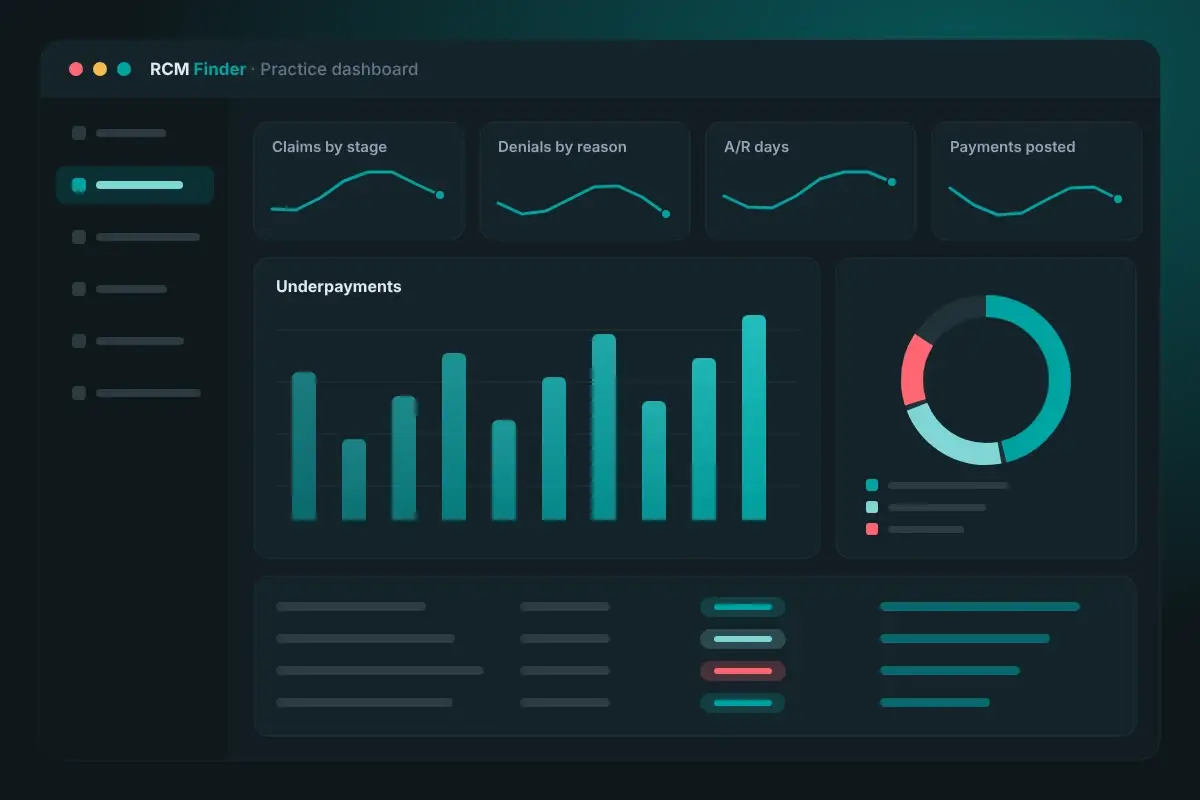
We run your claims inside the EHR you already use: charge capture, coding support, claim scrubbing, submission and remittance posting. You see every claim by stage in the RCM Finder portal.
By Awais Afzal | Healthcare Operations & Data Analyst
Published October 12, 2026 · Last reviewed October 12, 2026 · Next review April 12, 2027
Quick answer
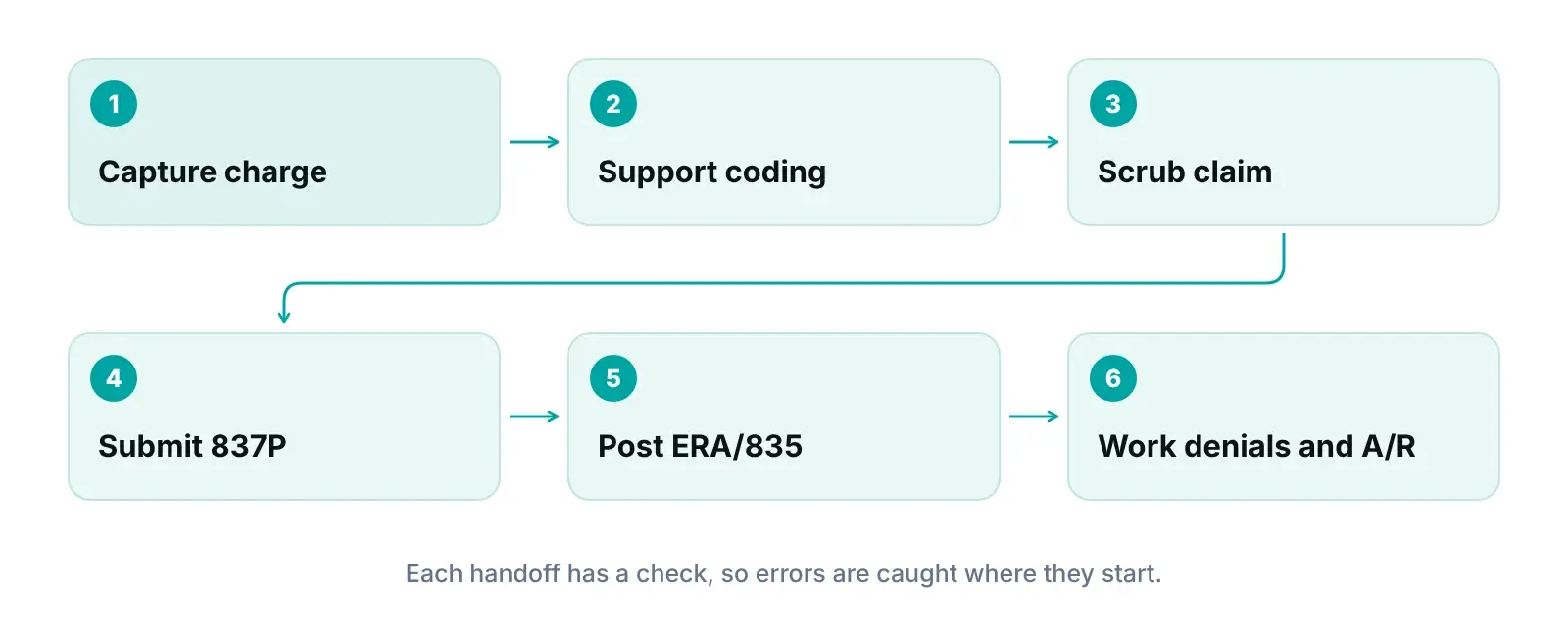
Medical billing services turn the care you document into paid claims. They capture each charge, support coding, scrub the claim for errors, submit it to the payer in the standard electronic format, post the remittance and work denials and unpaid claims. Outsourcing hands that chain to a team that is accountable for each step.
On this page
Medical billing and coding services follow one claim from the visit to the payment, and the work breaks at predictable points. We cover charge capture, coding support, claim scrubbing, submission and remittance posting, then work denials and unpaid claims. For a general overview, see our guide to medical claims billing services.
Claims go out in a standard electronic format. Medicare requires initial claims to be submitted electronically, with a waiver for small physician and practitioner practices (fewer than 10 full-time equivalent employees) and a few other cases (42 CFR 424.32). The HIPAA standards behind that are the ASC X12 837 professional claim (the electronic counterpart of the CMS-1500 form) and the 835 payment and remittance advice (45 CFR 162.1102 and 162.1602). Our CMS-1500 guide covers the form itself.
| Stage | What happens | Where it breaks | What we check |
|---|---|---|---|
| Charge capture | Each documented service becomes a charge | Missed or late charges; charges the note does not support | Visit list against notes and orders, daily |
| Coding support | Codes, modifiers and diagnoses are matched to the note | Wrong modifier; diagnosis not linked to the procedure | Note-to-code match; provider query when unclear |
| Claim scrubbing | The claim is checked before it leaves | Missing or invalid fields; payer-specific edits | Completeness, payer rules, authorization numbers |
| Submission (837P) | Claim sent electronically, usually through a clearinghouse | Rejections at the front door; late submission | Acknowledgements, rejections worked the same day |
| ERA/835 posting | Payments and adjustments applied line by line | Unposted remittances; deposits that do not match | ERA lines against deposits and expected amounts |
| Denials and A/R | Denied, short-paid and unpaid claims worked | Claims age past appeal or filing deadlines | Reason code, root cause, next action and owner |
Sources: 42 CFR 424.32 (Medicare electronic claim requirement); 45 CFR 162.1102 and 162.1602 (HIPAA claim and remittance standards), eCFR, October 2026. Other cells describe our operating pattern, not statistics.
Each stage has its own explainer: charge entry, claim scrubbing, charge and payment posting and ERA remittance. This page shows how the stages fit together as a service.
Find out where your claims stall
Our free audit follows a sample of your claims from charge to remittance and shows which stage costs you most.
A clean claim has nothing in it that stops the payer from processing it on time. For Medicare, the same idea has a legal limit: a claim must be filed within one calendar year after the date of service, with a few exceptions.
Medicare's regulation (42 CFR 405.902) defines a clean claim as one with no defect, impropriety, missing required documentation or special circumstance that prevents timely payment. In practice, HFMA's MAP Key CL-1 measures it as claims that pass edits with no manual intervention, divided by claims accepted for billing, counted the first time the claim is scrubbed. Use one definition and say which, so the number means the same thing every month. Our clean claims guide has the steps.
Under 42 CFR 424.44, a Medicare claim must be filed no later than the close of the period ending one calendar year after the date of service. If the last day falls on a federal nonworkday, the deadline moves to the next workday. Limited exceptions include error or misrepresentation by a Medicare contractor and certain retroactive entitlement cases.
Estimate what unbilled and unpaid claims cost you
Enter your monthly claim volume and collections in our revenue calculator to size the gap before your audit.
We start with a free audit, then take over billing in stages inside your EHR. You keep your system, your payer contracts and your data.
We review a sample of recent claims, denials, remittances and A/R aging, and how charges reach billing today. You get a written summary of where revenue slips and what to fix first. Pricing is quoted after the audit.
We put a Business Associate Agreement in place before accessing patient data, then set up role-based access limited to what each role needs.
We document your payer mix, where charges originate and your specialty's billing patterns. The portal applies specialty-aware logic per claim, with 35 specialties grouped into shared billing-pattern archetypes.
Our team works inside your existing EHR (for example PrognoCIS, eClinicalWorks or athenahealth). Your practice's time zone governs every staff member, onshore or offshore.
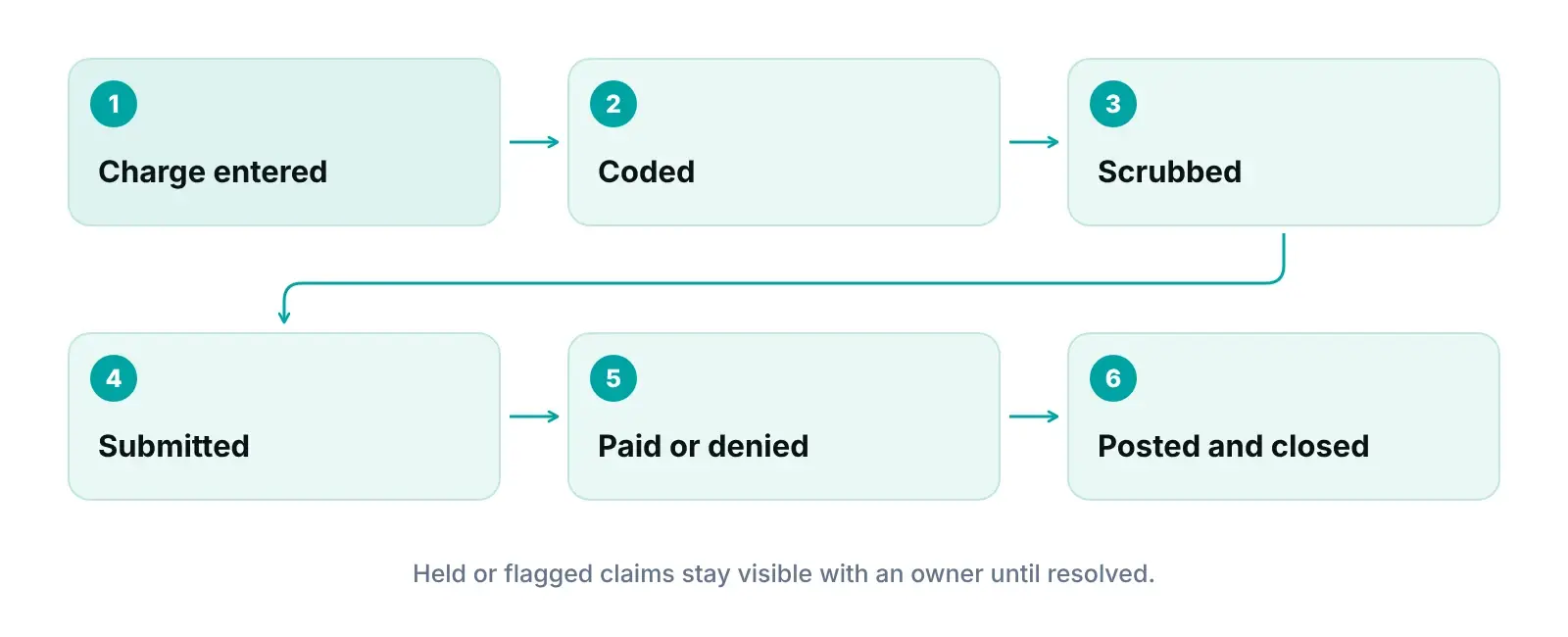
Charges are captured, coded with provider queries where needed, scrubbed, submitted and posted. Automation rules flag a claim for review, hold or advance a stage, or assign an owner.
You get weekly KPI reporting and a review of denial reasons, underpayments and aging. Each recurring problem gets an owner and an upstream fix.
Clients see their claims in the RCM Finder portal, tracked by stage with an owner on each. The portal checks claim data for completeness before submission, flags underpayments against expected amounts, and keeps role-based permissions and an audit log. Billing companies use the same portal across several client practices. We build our billing pipeline around how claims actually move through a practice: registration, charge entry, submission, payment and follow-up.
A medical billing company for small practices makes sense when billing errors or staffing gaps cost more than the contract. Outsourced medical billing services vary in scope, so compare models first. The three common models differ mainly in how much of the cycle you hand over and who owns the front end.
| Factor | In-house billing | Billing-only company | Full RCM partner |
|---|---|---|---|
| What you hand over | Nothing; your staff do it all | Claims, posting and follow-up after the visit | Front end, claims and back end |
| Eligibility and authorizations | Your front desk | Usually your front desk | Included in scope, often with virtual medical assistants |
| Denials and A/R | Whoever has time | Usually included; confirm old A/R | One team accountable for all |
| Visibility | Your own reports | Vendor reports; ask for claim-level access | Claim-level portal and weekly KPIs |
| Coverage when staff are out | Gaps unless cross-trained | Vendor covers absences | Vendor covers absences |
| Usually suits | Larger groups with a stable billing team | Practices with a strong front desk that need back-end help | Practices with rising denials and thin staffing |
Decision guide based on common operating models; no sourced statistics. Cost is quoted after a free audit.
If you are choosing between local and remote companies, our guide to medical billing companies and questions for choosing a medical billing company cover the comparison. For the full cycle, see our revenue cycle management services.
Not sure which model fits?
Talk it through with our team. If keeping billing in-house makes more sense for your practice, we will say so.
Billing rules attach to the service, so the same team applies different logic by specialty: global periods, time-based codes, units and modifiers. The portal applies this logic per claim, not per practice.
| Specialty group | What changes in billing | What we check |
|---|---|---|
| Orthopedics and general surgery | Medicare global periods: 0-day, 10-day and 90-day packages. Modifiers 24, 25, 57, 58, 78 and 79 mark unrelated or related visits and procedures | Service date against the global window; modifier against the note |
| Pain management | Procedure plus same-day visit (modifier 25 marks a significant, separately identifiable E/M). Levels, sides and units follow payer policy | Documentation for each level and side; payer bundling edits |
| Rehabilitation | Time-based codes: units follow documented minutes under the payer's counting rule. Medicare's 2026 KX threshold is $2,480 for PT and SLP combined, and $2,480 for OT | Minutes per code, total units, running visit and threshold totals |
| Anesthesia | Payment uses base units plus time units (time divided by 15 minutes) multiplied by a conversion factor | Start and stop times; base units; locality |
| Radiology and cardiac diagnostics | Professional component (modifier 26), technical component (TC) or global billing | Who owns the equipment and the read; modifier on each line |
| Oncology | Drug lines with units tied to dose, plus administration. Medicare requires JW for discarded drug and JZ when none was discarded, for single-dose containers | Drug, dose and units against the order and waste record |
| Behavioral health | Time-range psychotherapy codes, telehealth modifiers and place of service | Session length against the code; modality and place of service |
Sources: CMS Global Surgery Booklet (MLN907166); CMS CY 2026 therapy services page; First Coast Service Options, anesthesia reimbursement; CMS Medicare contracting article on PC/TC (JA0587); CMS transmittal R12067CP (JW/JZ). Pain, behavioral health and 'what we check' cells are operating logic, not statistics.
For code-level detail, see our guides to the 8-minute rule and modifiers 25 and 59. Browse all groups on our specialty RCM pages.
Billing results depend on what happens before the claim. We run billing as one of four connected services.
Marketing decides which patients and plans reach your schedule. We aim local SEO, Google Ads and reputation work at services you bill well.
Many billing errors start at registration. Our virtual medical assistants handle scheduling, eligibility, prior authorizations and intake.
Billing sits inside a full cycle: coding support, scrubbing, posting, denials and A/R follow-up, run by one accountable team.
Our portal shows where every claim stands and who owns the next step, for practices and billing companies.
A billing contract should say who does what, what you will see, who owns the data and how you leave. It should also include a Business Associate Agreement before any patient data moves. We list terms to look for, not prices; pricing differs by scope.
Ask about people, process and proof of process. Any vendor that handles your patient data is a HIPAA business associate, and HHS guidance lists billing and claims processing among business associate functions. The minimum necessary standard limits uses and requests to what is needed.
Our own setup: role-based access, audit logging, encrypted HTTPS connections, and we put a Business Associate Agreement in place before accessing patient data. For your side, use our HIPAA compliance checklist.
We would rather tell you now than after you sign. Here is where we fit and where we do not.
A good fit if you are
Probably not a fit if you are
What we would do first if we were running your practice's revenue cycle tomorrow.
We compare each day's visit list with captured charges, so a missed or late charge is found within a day, not at month end.
When a code, modifier or diagnosis does not match the note, we send a provider query. The provider decides; we never change documentation.
Rejections at submission are fast to fix and easy to lose. We work them daily so they are less likely to become timely filing problems.
We match ERA lines to deposits and expected amounts, so short payments and unposted remittances show up.
Medicare's limit is one calendar year after the date of service; every other payer's limit comes from its contract. We put each deadline in the work queue.
We say whether a clean claim rate follows HFMA's CL-1 or another definition, so the trend stays honest month to month.
Payments should go to an account in your name, and your claim data should stay yours. Put access and data-return terms in any billing contract, including ours.
Medical billing services cover charge capture, coding support, claim scrubbing, electronic claim submission, remittance posting, denial follow-up and A/R work. Some vendors add eligibility checks, prior authorizations, patient statements and reporting. Scope differs between companies, so ask exactly which stages are included, whether old A/R is worked and what reports you will receive.
Pricing depends on claim volume, specialty, payer mix and which stages you hand over. Billing companies price in different ways, so compare what each quote covers. We quote after a free practice audit, so the price reflects your actual workload. Ask any vendor what is included and what is billed separately.
It can be, when billing errors, unworked denials or staff gaps cost more than the contract. It is less useful if your claims are already clean and your staff have time to follow up. A free audit of your claims and A/R aging shows which case you are in, and we will say if in-house billing fits better.
Under 42 CFR 424.44, a Medicare claim must be filed within one calendar year after the date of service, with limited exceptions such as certain contractor errors or retroactive entitlement. Other payers set their own limits, often in the contract, so check each payer and track the deadline from the date of service.
No. Our team works inside your existing EHR, for example PrognoCIS, eClinicalWorks or athenahealth, using the access you grant. We add our portal for claim-stage tracking, underpayment checks and reporting. We do not claim official partnerships with EHR vendors; we work in your system the way your staff do.
HIPAA lets practices use billing vendors as business associates, provided a Business Associate Agreement is in place and the vendor safeguards the data. Before sharing access, confirm the agreement is signed, access is limited by role, activity is logged and connections are encrypted. We put a Business Associate Agreement in place before accessing patient data. This is general information, not legal advice.
Guides from our operations team on topics covered on this page.
Tell us about your practice. We will contact you using the details you give.
Pricing is quoted after the audit, based on your volume and the services you choose. Prefer to talk? Call +1 (302) 556-2288.
Tell us about your practice
About the author: Awais Afzal
Healthcare Operations & Data Analyst, RCM Finder
Awais has spent more than 16 years in healthcare digital marketing and clinical operations management. He builds data-driven revenue cycle blueprints for high-ticket medical practices and leads product development of the RCM Finder portal. More about our team.
How we write: every figure, code and rule on this page was checked against the primary source listed below and independently fact-checked before publishing. We re-review this page every six months. Last reviewed October 12, 2026; next review April 12, 2027.
We use cookies to understand how our site is used and to measure our advertising. You can accept or reject non-essential cookies. See our Privacy Policy.