
Dental practice management is the business side of running a dental office: the front desk and schedule, insurance verification, coding and claims, denials and collections, patient communication and marketing. Strong management means a full schedule, claims that match the record, someone who owns unpaid claims, and patients who return.
Most dental offices do not have one big problem. They have small leaks at several handoffs: a call that goes unanswered, a benefits check that is skipped, a claim that does not match the chart, a denial that nobody appeals. This guide is for owners and office managers who want to see the whole loop and decide where to work first.
It orients and routes. Each area gets a short section and a link to the deeper guide, so you can read what you need. If you are choosing software, start with the dental practice management software comparison. For a growth plan, see the dental marketing plan.
Key takeaways
- Dental practice management is one loop: schedule, eligibility, coding, claims, collections, recall and marketing.
- Verify benefits before treatment and treat every estimate as a non-guaranteed estimate.
- Code to the CDT edition in effect on the date of service and keep the claim matched to the record.
- Read the EOB before appealing, and give every unpaid claim a named owner.
- Check ADA advertising ethics, the FTC review rule and HHS tracking guidance before marketing.
- Fix the front desk and insurance steps first, then add new-patient channels.
What does dental practice management cover?
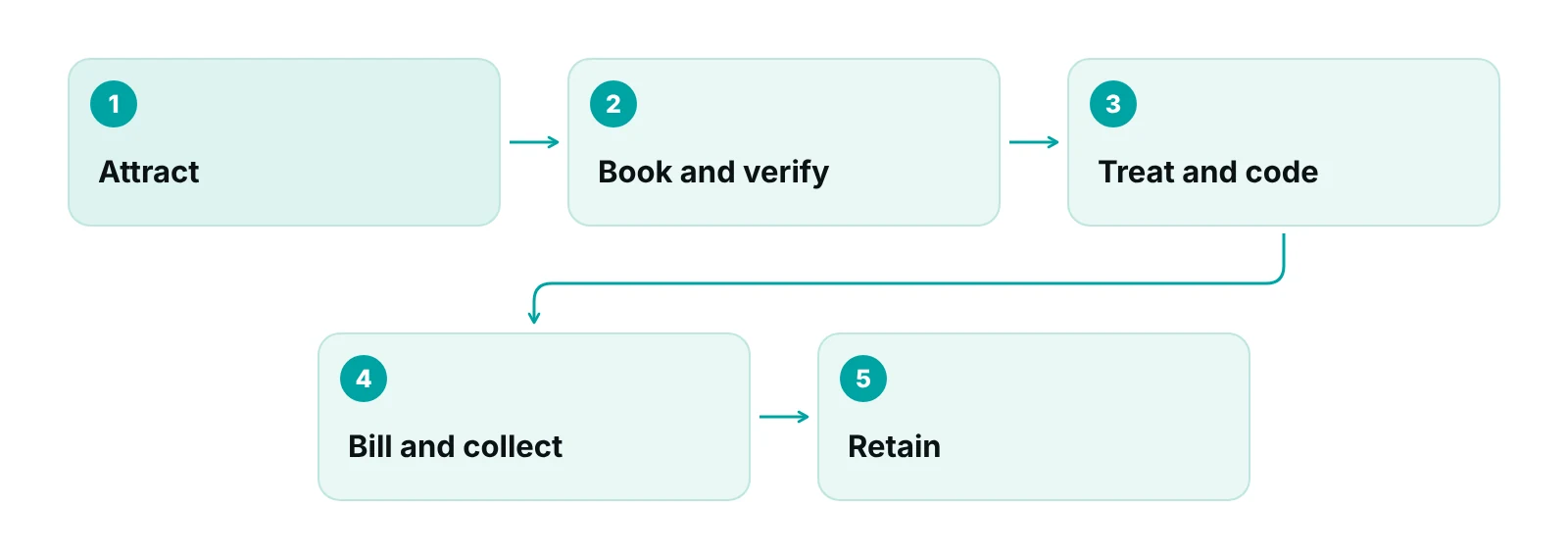
Dental practice management is the business work that surrounds the clinical work: the schedule and front desk, insurance and intake, coding and claims, collections, patient communication, marketing and the software that ties them together. It is one loop. When one step fails, the cost usually shows up later, in a different place.
A skipped benefits check becomes a denied claim two weeks on. A missed recall becomes an open chair months later. A website that cannot book a patient wastes the ad that paid for the click. Reading the practice as one loop is the first step in any plan for dental practice growth.
Dental offices have a distinct shape. Preferred provider organizations accounted for 86% of the dental benefit market in 2022, according to the ADA, so most patients arrive with annual maximums, deductibles and frequency limits that change what the practice can collect. The ADA Health Policy Institute reports that 2024 national dental spending was $189 billion, with out-of-pocket payments the largest source, followed by private insurance (ADA HPI). The practice therefore collects from two payers on nearly every visit: the plan and the patient.
| Area | The question it answers | What goes wrong when it is weak |
|---|---|---|
| Front desk and schedule | Is the chair full with the right work? | Gaps, late cancellations, missed new-patient calls |
| Intake and eligibility | What will the plan actually pay? | Surprise balances, denied claims |
| Charge capture and claims | Was every completed procedure billed correctly? | Missed charges, rejected or downcoded claims |
| Denials and A/R | Is unpaid money being worked by someone? | Aging claims that are never appealed |
| Patient communication | Do patients come back and pay? | Lapsed recalls, unpaid patient balances |
| Marketing | Are new patients finding and choosing us? | Spend with no tracking, rule violations |
| Software and security | Does the system support the work and protect data? | Manual workarounds, weak access control |
Source: RCM Finder operations framework; plan-market context from ADA (2022 data) and ADA Health Policy Institute (2024 data).
How should the front desk and schedule be run?
Run the schedule as the practice’s capacity and the front desk as the process that fills it. Every call, form and confirmation either protects a booked appointment or loses one. The front desk is also where most insurance and balance problems begin, because it collects the information every later step relies on.
A workable front desk routine is short and written down:
- Answer new-patient calls live where possible, and collect the insurance details on the first contact.
- Confirm every appointment in the patient’s preferred channel, and note who confirmed.
- Keep a short list of patients who can come in early, so a cancellation becomes a filled chair.
- Review tomorrow’s schedule each afternoon for missing insurance details and unsigned forms.
- Schedule the next visit or recall before the patient leaves the chair.
Coverage is the usual weak point: one person on leave and calls go unanswered. Some practices cover it with a remote assistant who works in the practice’s own time zone. Our dental virtual assistant guide explains which tasks suit remote staff, such as calls, scheduling, eligibility checks and intake, and which should stay in the office. The team works inside the practice’s existing software, so the schedule stays in one place.
How do intake and insurance verification protect revenue?
Verify benefits before the visit, record what the plan says in a consistent place, and give the patient an estimate before treatment starts. This is the cheapest point in the cycle to prevent a denial, and it is also where the most administrative money is spent.
The CAQH Index reported that dental spending on eligibility and benefit verification rose 15% to $2.1 billion in 2023, the largest increase in dental administrative spending, and that moving from portals and manual checks to automated electronic checks could save an estimated $580 million (ADA News, 2025). The ADA describes three methods: fully electronic, partially electronic through a plan portal, and manual by phone, fax or mail. CMS lists the 270/271 transaction as the adopted standard for eligibility and benefit inquiries (CMS).
A verification record is only useful if it captures the terms that change payment:
- Subscriber, group number, plan type and whether the plan is fully insured or self-funded.
- Annual maximum, amount used so far, deductible met and coverage percentages.
- Frequency limits, waiting periods and any downgrade or least-expensive-alternative clause.
- Whether a secondary plan exists and which plan is primary.
- Coverage for the planned procedures, not only the plan’s general summary.
Annual maximums matter more than they look. National Association of Dental Plans data cited by ADA News in 2025 put about a third of in-network maximums between $1,000 and $1,500, and the ADA Health Policy Institute found that 3.4% of dental patients reached the typical maximum in 2024 (ADA News). Few patients hit the cap, but those who do pay a larger share, so the check is worth doing before a large treatment plan.
Be clear with patients that an estimate is not a promise. The ADA notes that estimated payments are not guaranteed and that benefits change if coverage ends or other claims are paid first (ADA). A written financial policy, which the ADA calls a must-do (ADA), puts that message in front of the patient. The full workflow is in our dental insurance verification guide.
How do coding and charge capture keep claims clean?
Code what was done, using the CDT edition in effect on the date of service, report the full fee, and make sure the claim matches the patient’s record. Those three habits prevent most avoidable rejections and keep the practice on solid ground if a payer audits.
The ADA states that HIPAA requires the code set version in effect on the date of service, regardless of when the claim is submitted, and warns that some software truncates code descriptors, so the full descriptor should be checked (ADA). It also advises that claims match the information in the patient’s record and that the full fee be reported (ADA). For multi-visit prosthetic work, the date-of-service rule varies by state, carrier and contract, so the ADA suggests predetermining benefits and applying the rule consistently.
Charge capture is the internal check that every completed procedure reached a charge. A simple version:
- At the end of each day, compare the completed procedures in the chart with the charges on the ledger.
- Flag any appointment with notes but no charge, and any charge without clinical notes.
- Hold claims that need an attachment, narrative or radiograph until it is attached.
- Send claims the same week, and track the ones that have not gone out.
For code-level detail, read our dental billing and coding guide. For the full path from verification to payment, see dental revenue cycle management. If the office is deciding which billing tasks to hand off, the dental billing services guide compares outsourcing, in-house and hybrid models. CMS also lists the 837 as the adopted claim standard covering institutional, professional and dental claims, with the 835 for electronic remittance (CMS).
How should denials and unpaid claims be worked?
Read the explanation of benefits first. Many reductions are plan design, not errors, and only the unexplained ones need an appeal. A named person should own every claim until it is paid, appealed or written off with a reason.
The ADA’s steps for a rejected or denied claim begin with checking for a coding error and confirming the CDT version, then gathering documentation, submitting a written appeal in the carrier’s required format, requesting a call with the dental consultant, and exhausting all appeal levels before escalating (ADA). The ADA defines downcoding as a payer paying a claim with a different code than the one reported, and advises checking the EOB before appealing, because a plan-design result usually needs no appeal (ADA News, 2026).
| Denial type | First check | Suggested documentation |
|---|---|---|
| Scaling and root planing | Pocket-depth and frequency rules in the plan | Radiographs showing bone loss, periodontal charting, narrative |
| Periodontal maintenance | Time window after scaling and root planing | Radiographs, periodontal charting, narrative |
| Core buildup | Whether the plan bundles it into the crown | Radiographs, photos, narrative |
| Bundling | Which codes were combined | Narrative |
| Downcoding | EOB wording and the code originally submitted | Radiographs, narrative |
| Not dentally necessary | Plan’s necessity criteria | Radiographs, charting, study models, narrative; request consultant contact |
Source: ADA, Responding to Claim Rejections (accessed October 2026).
Two details cause repeat work. For secondary coverage, send the claim to the secondary payer with a copy of the primary plan’s EOB, report the full fee, and do not post a write-off until all plans have paid (ADA). For patient balances, the same written financial policy applies. The follow-up routines, aging reports and escalation steps are in our dental accounts receivable and collections guide.
How do you keep patients coming back and speaking well of you?
Retention is an operations job, not a marketing job. A patient returns when recall is reliable, the treatment plan is followed up, and the bill matches what was explained. The need is real: the ADA reports that 45% of the U.S. population had a dental visit in the past 12 months in 2022, with 52% for children and seniors and 40% for adults aged 19 to 64.
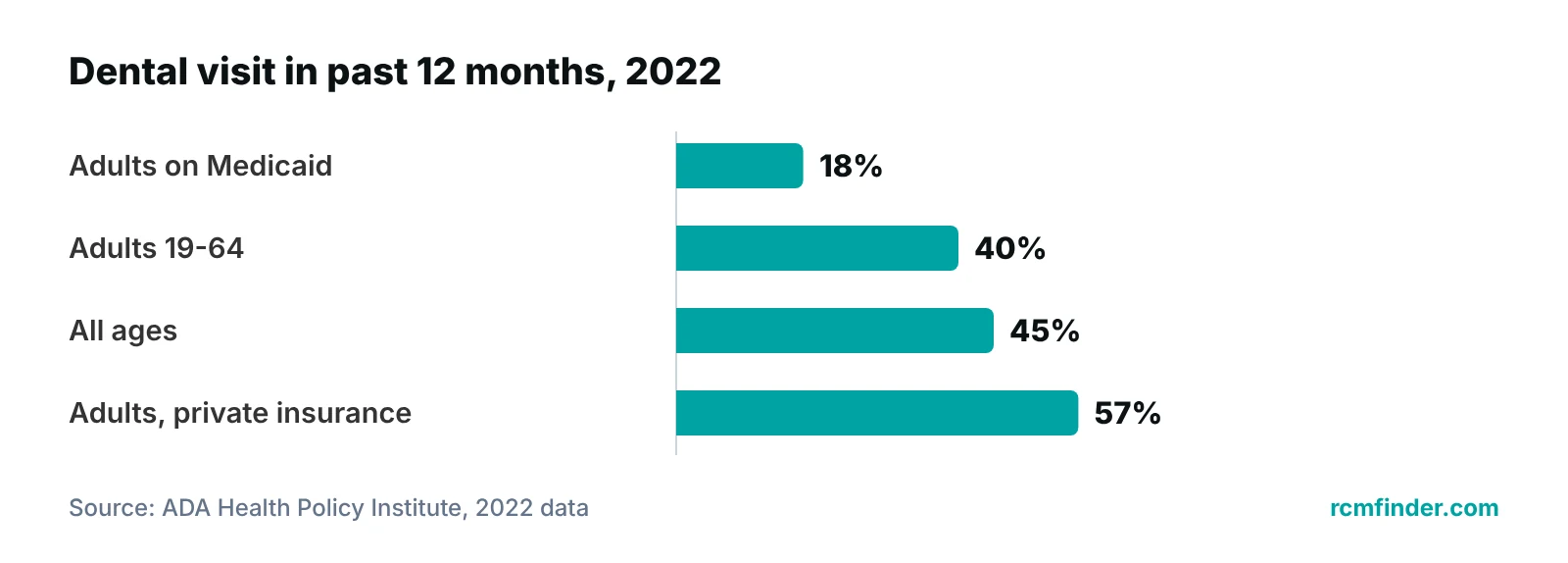
Many patients simply do not come in every year, so a practice cannot assume recall will take care of itself. Build a recall list, reach patients who are overdue, follow up on accepted but unscheduled treatment, and review the list monthly. Our dental patient retention guide sets out the recall, reactivation and follow-up routines in detail.
Reviews belong in the same loop. The FTC’s consumer reviews rule took effect on October 21, 2024, and prohibits fake reviews, reviews from insiders that hide the relationship, and suppressing reviews through intimidation or unfounded legal threats; incentives cannot be tied to a particular sentiment (FTC). The dental reputation management guide covers how to ask, reply and monitor without breaking those rules or patient privacy.
How to grow a dental practice: which marketing channels matter?
Grow through the channels that turn searches into booked appointments, and fix the front desk and insurance steps first, so the new patients you win are not lost at the phone or the claim. Marketing adds volume to whatever the operations can handle.
Each channel has one job and one rule to check. The ADA Principles of Ethics say a dentist may advertise but not in a way that is false or misleading in any material respect, and that websites and search optimization must follow the same standard (ADA). State dental boards add their own rules, so confirm yours. HHS also warns that tracking technologies on appointment scheduling pages that capture an email address or reason for care can involve protected health information, and that a vendor receiving it needs a business associate agreement (HHS).
| Channel | Its job | Rule or risk to check | Go deeper |
|---|---|---|---|
| Website | Convert visits into booked appointments | Truthful content; tracking on scheduling and form pages | Dental website design |
| Local search (SEO) | Be found for nearby dental searches | Truthful claims; consistent practice details | Dental SEO guide |
| Paid search (Google Ads) | Capture high-intent searches now | Ad accuracy; do not send patient data to ad platforms | Dental PPC guide |
| Social media | Show the team and build familiarity | No patient information or images without authorization | Dental social media guide |
| Reviews | Build trust before the first call | FTC review rule; no incentives tied to sentiment | Dental reputation guide |
Source: ADA Principles of Ethics 5.F (accessed October 2026); HHS online tracking guidance (accessed October 2026); FTC (2024).
The deeper guides are dental website design, the dental SEO guide, dental PPC and Google Ads and dental social media marketing. To put them in order, start with the 90-day dental marketing plan, then use the dental digital marketing guide for channel budgets and tracking.
Where do software and security fit?
Software should support the workflow you have written down, not define it. Choose it after you can describe how a patient moves from first call to final payment. Our dental practice management software comparison lists the insurance, data export and demo questions, so this guide does not repeat them.
Security is a practice duty whichever system you choose. HHS lists billing, claims processing and practice management among business associate functions, and cloud providers that store or process electronic protected health information are business associates too; a covered entity needs a business associate agreement before sharing protected information (HHS). That applies to billing companies, clearinghouses, hosting vendors and remote staff providers alike.
Ask any vendor for role-based access, an audit log, encrypted connections and a signed agreement before they see patient data. Our own portal offers role-based staff permissions, audit logging and encrypted HTTPS connections, and we put a Business Associate Agreement in place before accessing patient data.
What should an owner review every month?
Review a short set of numbers monthly, with one owner per number. The list below needs no benchmark to be useful: the trend over time and the reasons behind it show where to act.
- New patients by source, and how many calls became booked appointments.
- Cancellations, no-shows and how many open slots were refilled.
- Claims submitted, claims rejected and the top denial reasons.
- A/R by age and payer, including claims with no payer response.
- Patient balances by age and the number sent for follow-up.
- Overdue recall and unscheduled accepted treatment.
- Reviews received and replied to.
Each number belongs to a role: front desk, billing, treatment coordinator or owner. If billing and A/R follow-up are the weakest link, the end-to-end revenue cycle management service describes how outsourced support works with your team. Use the audit below to see where claims stall today.
See where the dental cycle leaks
A free practice audit reviews claims, EOBs and denials and shows which problems need a process change and which need extra hands.
“Fix the loop in order. Pay attention to the front desk and eligibility before you buy more traffic, because every new patient passes through them.”
— Awais Afzal, Healthcare Operations & Data Analyst
Our recommendations
- Map the patient path before changing anything. Write down every step from first call to final payment and name an owner for each. Gaps and double handling become visible in an hour.
- Verify benefits before treatment, not after the claim. Make a benefits check a required step before the visit and record the plan terms in one place the whole team uses.
- Hold a weekly denial review. Spend 30 minutes each week on rejected and downcoded claims. Group them by reason, fix the cause at the front desk, and appeal what is worth appealing.
- Treat recall as a revenue process. Give recall and accepted-treatment follow-up an owner and a monthly report. Waiting for patients to call is not a plan.
- Put the rules into your marketing checklist. Before any campaign, check ADA advertising ethics, your state dental board, the FTC review rule and tracking on any page that takes patient details.
- Get a business associate agreement from every vendor. List each vendor that touches patient data and confirm the agreement is signed and on file before sharing anything.
Bottom line
Dental practice growth comes from running the whole loop: a front desk that books and verifies, claims that match the record, someone who owns denials and A/R, recall that works, and marketing that follows the rules. If the money side is where it breaks, our practice management system works with practices and billing companies, and a free audit shows where to start.
Frequently asked questions
What is dental practice management?
Dental practice management is the non-clinical work of running a dental office: scheduling and the front desk, insurance verification, coding and claims, collections, patient communication, marketing and the software and security around them. The aim is a steady schedule, claims that pay and patients who return.
How do you grow a dental practice?
Start by fixing the loop: answer calls, verify benefits, bill accurately and run recall. Then add marketing channels that bring in new patients, such as a bookable website, local search and reviews, within ADA advertising ethics and your state board’s rules. Track new patients by source so you know what works.
What should a dental practice fix first?
Fix whatever loses money earliest. For most offices that is the front desk and eligibility: missed calls, incomplete insurance details and no benefits check before treatment. Problems there turn into denials and patient balances later, which cost more to repair than to prevent.
Is a treatment estimate a guarantee of payment?
No. The ADA notes that estimated payments are not guaranteed, because benefits change if coverage ends or other claims are paid first. Give the patient a written estimate, explain it in your financial policy, and say plainly that the final amount depends on what the plan pays.
Does a dental practice need a business associate agreement with its billing company?
Yes, if the company creates, receives, maintains or transmits protected health information for the practice. HHS lists billing, claims processing and practice management as business associate functions. Cloud, clearinghouse and software vendors that handle patient data usually need one too.
Should a dental practice outsource billing?
It depends on the office. Many practices keep patient-facing steps, such as intake and estimates, in house and outsource claims follow-up or A/R. Compare the options against your own denial and A/R reports, and read the dental billing services guide before deciding.
Get your free practice audit
Tell us about your practice. We will contact you using the details you give.
- A review of your recent claims, denials and A/R aging
- Where your front desk and prior authorizations slow payment
- A prioritized fix list you keep, whether or not you hire us
Pricing is quoted after the audit, based on your volume and the services you choose. Prefer to talk? Call +1 (302) 556-2288.
Sources
- Dental Care Market — ADA Health Policy Institute (2024)
- Benefit verification drives increased administrative spending in dental offices — ADA News (2025)
- Introduction to Dental Benefits — American Dental Association (2022)
- Responding to Claim Rejections — American Dental Association (accessed Oct 2026)
- Pre-Authorizations — American Dental Association (accessed Oct 2026)
- Participating in a Plan — American Dental Association (accessed Oct 2026)
- ADA Guidance on Coordination of Benefits — American Dental Association (accessed Oct 2026)
- Dear ADA: Annual Maximums — ADA News (2025)
- Dear ADA: Downcoding — ADA News (accessed Oct 2026)
- Adopted Standards and Operating Rules — CMS (accessed Oct 2026)
- Business Associates — HHS Office for Civil Rights (accessed Oct 2026)
- Use of Online Tracking Technologies by Covered Entities — HHS Office for Civil Rights (accessed Oct 2026)
- Consumer Reviews and Testimonials Rule: Questions and Answers — FTC (2024)
- Principles of Ethics and Code of Professional Conduct: Veracity — American Dental Association (accessed Oct 2026)
Disclaimer: This article is educational and is not legal, coding, tax or compliance advice. Advertising, privacy and payer rules differ by state and by plan and change over time, so confirm current requirements with your state dental board, your attorney and each payer before acting. CDT is a registered trademark of the American Dental Association; official code descriptors are not reproduced here.
